

Education shapes the future of communities, influencing economic mobility, civic engagement, and employment opportunities. In Massachusetts — known for its strong public schools, world‑class universities, and history of educational innovation — policy decisions carry significant weight.
These decisions determine how schools operate, how resources are distributed, and how students learn from early childhood through higher education. Understanding education policy is essential for anyone who wants to influence the direction of the state’s education system. With the right foundation and training, education leaders can interpret policy, guide implementation, and advocate for meaningful change.
What’s Education Policy?
Education policy broadly refers to the laws, regulations, guidelines, and administrative mandates that govern how education systems operate. These policies exist at the federal, state, and local levels, collectively shaping the expectations, rights, and responsibilities of students, educators, institutions, and governing bodies. At its core, education policy provides a structured framework to ensure that schools function consistently, fairly, and in alignment with broader societal goals.
Federal Policy
At the federal level, education policy includes laws that protect student rights, increase access, and establish national priorities. Examples include legislation that supports students with disabilities, protects student privacy, and ensures access to financial aid for higher education. Federal policy often sets the tone for what states must provide, while still allowing states flexibility in how they implement these requirements.
State Policy
State-level education policy plays a more direct role in shaping students’ and educators’ day‑to‑day experiences. States determine academic standards, teacher licensure requirements, school funding formulas, and accountability systems. They also oversee higher education policy, including institutional governance, program approval, and statewide initiatives aimed at improving college access and workforce alignment.
Local Policy
Local districts and institutions add another layer of policy through school committee decisions, district regulations, and campus‑specific procedures. These local policies interpret and apply federal and state requirements in ways that reflect specific community needs and priorities.
Education policy isn’t static. It evolves in response to research, demographic changes, economic demands, and political priorities. For example, shifts in workforce needs may lead to new graduation requirements or expanded career and technical education pathways. Advances in technology may prompt new policies on digital learning, cybersecurity, or data privacy. Social and cultural movements may influence policies related to student access and well‑being.
Because education policy touches every part of the learning ecosystem, it requires leaders who can understand its complexities, anticipate its implications, and guide its implementation.
What Are Education Policies Designed to Do?
Education policies serve as blueprints for how schools and colleges operate. They’re designed to create consistency, fairness, and accountability across the education system while ensuring that institutions meet the needs of students and society.
Promoting Equity and Inclusion
One function of education policy is to ensure that all students have access to high‑quality learning opportunities. Policies focused on equity aim to reduce disparities related to income, race, disability, language, or geography.
For example, funding mechanisms that support low‑income districts or laws that guarantee services for students with disabilities help ensure that every student receives the support they need to succeed. In Massachusetts, equity remains a central priority as the state works to close achievement gaps and expand access to early childhood education, advanced coursework, and college pathways.
Setting Academic Standards and Quality Control
Education policies define what students should learn and how learning is measured. These standards guide curriculum development, instructional practices, and assessment systems. By establishing clear expectations, policymakers help ensure that students across the state receive a consistent and rigorous education. Quality control policies also influence teacher preparation, school accreditation, and program evaluation, helping maintain high standards across K-12 and higher education.
Defining Accountability Systems
Accountability policies outline how schools and educators are evaluated. They may include standardized testing, performance metrics, teacher evaluations, and improvement plans for underperforming schools. The goal is to ensure that institutions meet established standards and that students make progress. In Massachusetts, accountability frameworks help identify schools needing additional support and guide state interventions when necessary.
Guiding Resource Allocation
Education policy determines how public funds are distributed and how they must be used. This includes budgeting for staffing, facilities, transportation, technology, and student services. Effective resource allocation policies help ensure that schools have the tools they need to operate and support student learning. Funding formulas, grant programs, and capital investment plans all fall under this category.
Ensuring Safe and Orderly Environments
Policies related to school safety, student behavior, and crisis response help create environments where students can learn without disruption or harm. These may include anti‑bullying laws, disciplinary guidelines, emergency preparedness protocols, and mental health initiatives. Safety policies are essential for maintaining trust and stability within school communities.
Aligning Education With Societal and Workforce Needs
As the economy and needs of the community evolve, education policy must adapt to prepare students for emerging careers and civic responsibilities. Policies may address teacher training requirements; science, technology, engineering, and mathematics (STEM) education; digital literacy; and partnerships between schools and industry. In Massachusetts, where innovation and technology are growing sectors, aligning education with workforce needs is a major priority.
Ensuring Legal Compliance
Schools must adhere to a wide range of federal, state, and local laws. Policies help ensure compliance with regulations related to student rights, data privacy, nondiscrimination, and financial reporting. For example, laws such as the Family Educational Rights and Privacy Act (FERPA) protect student information, while civil rights laws ensure equal access to educational opportunities.
How Massachusetts Education Policy Works?
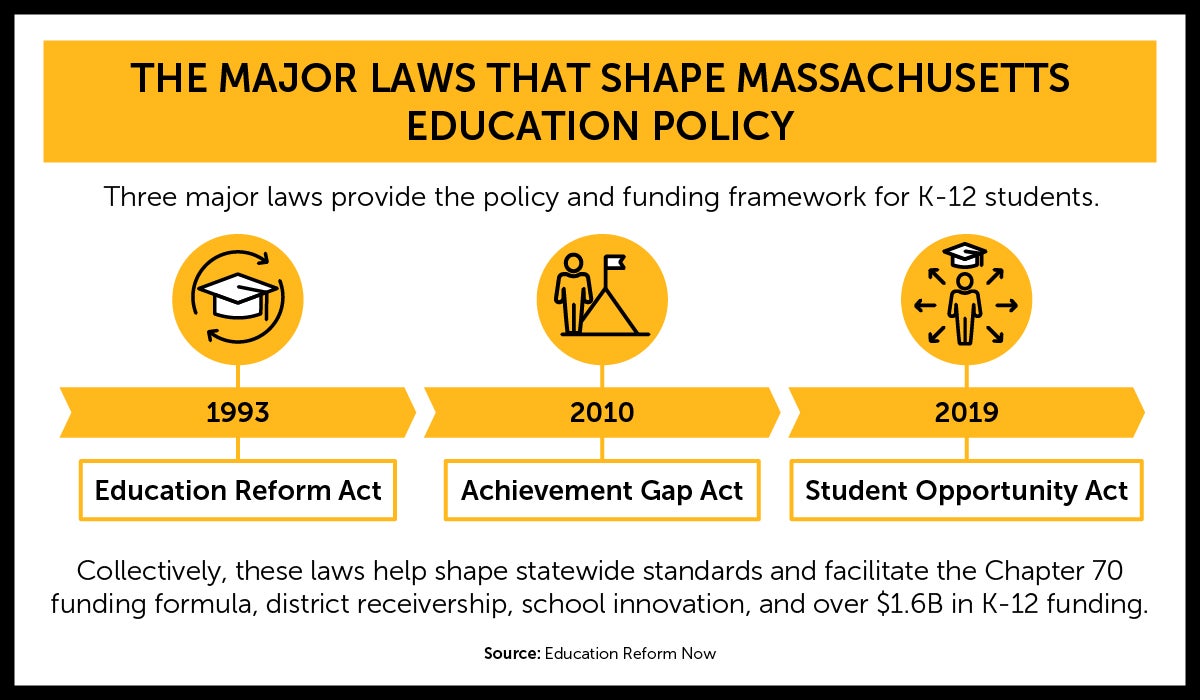
Massachusetts education policy is shaped through a multilayered system of state agencies, legislative bodies, and local decision-makers who work together to guide both K-12 and higher education. Federal laws establish broad protections and requirements, while the Commonwealth plays the central role in determining academic standards, funding structures, accountability systems, and statewide initiatives. Understanding how these entities interact is essential for anyone who wants to influence the direction of education in the state.
Massachusetts Board of Elementary and Secondary Education
At the top of the K-12 governance structure is the Massachusetts Board of Elementary and Secondary Education (BESE). BESE sets statewide policies, approves academic standards, oversees accountability frameworks, and votes on major regulatory changes. It also has the authority to approve charter schools and intervene in struggling districts. Its decisions shape the expectations for every public school in the state, including curriculum guidelines and graduation requirements.
Massachusetts Department of Elementary and Secondary Education
The Massachusetts Department of Elementary and Secondary Education (DESE) is responsible for implementing the policies BESE adopts. DESE manages state assessments, administers funding programs, monitors district performance, and provides technical assistance to schools. BESE sets the overall vision, while DESE handles the day‑to‑day work of turning policy into practice.
Massachusetts Board of Higher Education
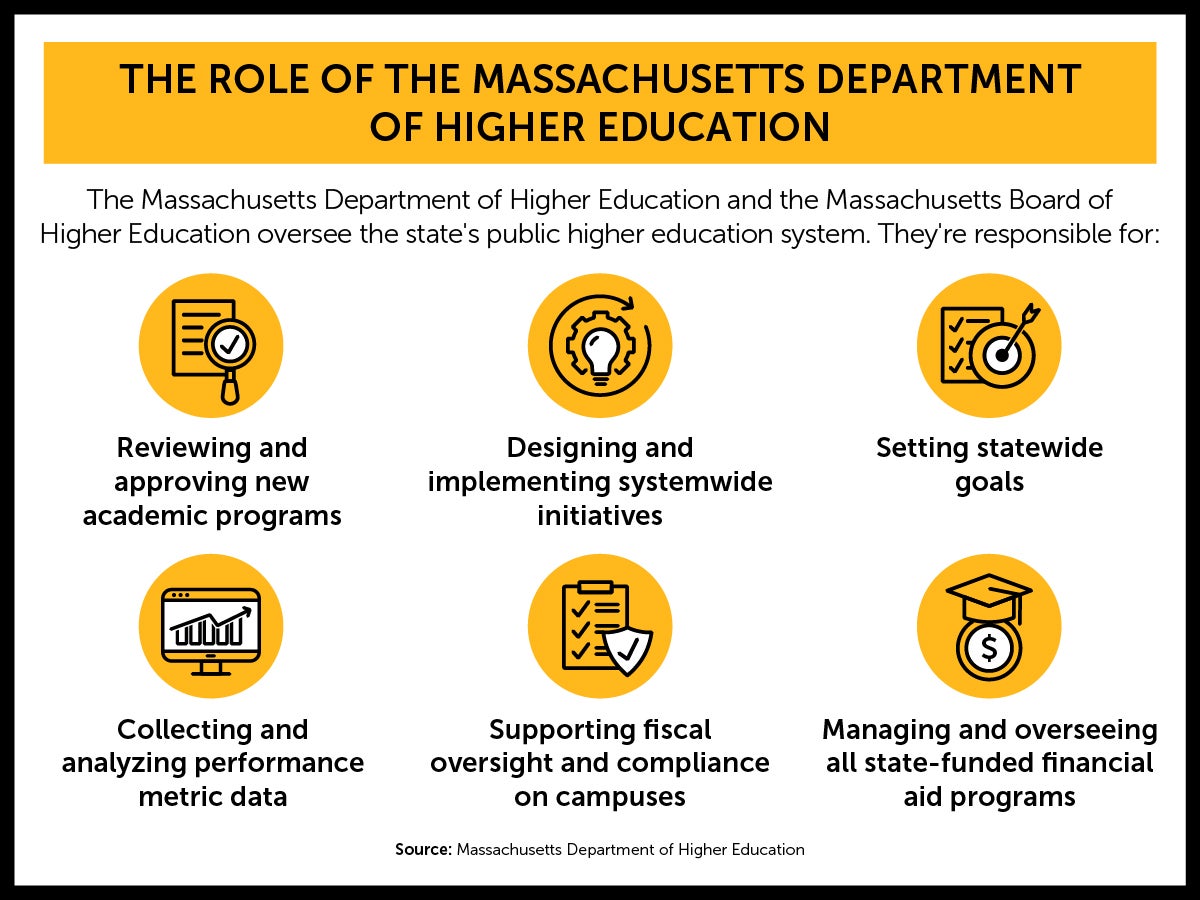
The Massachusetts Board of Higher Education (BHE) oversees the state’s public colleges and universities, including community colleges, state universities, and the University of Massachusetts system. The BHE sets statewide goals for college access, affordability, and workforce alignment. It also approves new academic programs and monitors institutional performance.
Massachusetts Department of Higher Education
The Massachusetts Department of Higher Education (DHE) carries out the board’s directives. The DHE manages financial aid programs, coordinates transfer pathways, supports campus leadership, and develops initiatives that strengthen the state’s higher education system. It also ensures that policies are implemented consistently and effectively across institutions.
Massachusetts Local School Districts
Local school districts also play a major role in shaping Massachusetts education policy at the community level. School committees set district policies, approve budgets, and hire superintendents. Superintendents interpret state policies and lead the implementation of instructional programs, staffing decisions, and improvement strategies. This local governance structure allows communities to tailor educational practices to their specific needs while remaining within the statewide framework.
Examples of Massachusetts Education Policies and Initiatives
To understand how Massachusetts education policy functions in practice, it helps to consider policies and initiatives shaping the state’s K-12 and higher education landscape. These examples highlight the state’s commitment to equity, affordability, academic quality, and workforce readiness.
MassEducate and MassReconnect
Massachusetts has launched major affordability initiatives aimed at expanding access to higher education. MassEducate and MassReconnect provide free community college tuition and fees for residents, helping remove financial barriers for both recent high school graduates and adult learners. These programs reflect the state’s broader goal of strengthening the workforce and increasing college completion rates.
MASSGrant Plus Expansion
The expansion of MASSGrant Plus increases financial aid for low‑income students attending public institutions. By covering tuition, fees, and books, the program helps ensure that cost doesn’t prevent students from pursuing higher education. This initiative supports the state’s long‑term economic strategy by making college more accessible to underserved populations.
Student Support Investments
Massachusetts has increased funding for mental health services, academic advising, and student success programs across public colleges and universities. These investments recognize that affordability alone isn’t enough; students also need strong support systems to persist and graduate.
High School Graduation Framework Reform
The state is moving away from the high‑stakes 10th‑grade Massachusetts Comprehensive Assessment System (MCAS) model and toward a more holistic graduation framework. This shift reflects a broader effort to measure student learning in more authentic and meaningful ways rather than a one-size-fits-all approach.
Early Literacy Reform
Massachusetts is considering legislation that would require districts to adopt evidence‑based reading curricula. This initiative aims to improve early literacy outcomes by ensuring that instructional materials align with research on how children learn to read.
Vocational‑Technical School Admissions Updates
The state continues to revise admissions regulations for vocational‑technical schools to promote fairness and expand access. These updates are designed to ensure that all students, including those from historically underserved communities, have equitable opportunities to pursue career and technical education.
Equity Strategic Framework
Massachusetts has implemented a statewide equity framework that guides districts in addressing disparities in student achievement, access, and opportunity. This includes targeted support for multilingual learners, students with disabilities, and students from low‑income backgrounds. The framework reinforces the state’s commitment to closing gaps and improving outcomes for all learners.
How EdD Graduates Influence Massachusetts Education Policy
Massachusetts education policy is shaped not only by agencies and legislation but also by the leaders who interpret, implement, and advocate for change. Educational leaders with a Doctor of Education (EdD) degree play a critical role in this process. Their advanced training in leadership, research, organizational change, and policy analysis positions them to influence decisions at every level of the education system.
District Leadership
EdD graduates can serve in district‑level leadership roles, such as superintendent, assistant superintendent, curriculum director, and chief academic officer. In these positions, they translate state policies into actionable strategies, oversee instructional programs, and guide school improvement efforts. Their understanding of policy helps them make informed decisions that align with state expectations while meeting local needs.
State Leadership
Others work in state agencies, including the DHE and DESE, where they contribute to policy development, program evaluation, and statewide initiatives. Their expertise allows them to analyze data, assess the impact of existing policies, and recommend changes that support equity and student success. EdD‑trained professionals often lead task forces, advisory groups, and cross‑agency collaborations that shape the direction of Massachusetts education policy.
Higher Education Leadership
EdD graduates also influence policy through leadership roles in higher education, such as deans, provosts, and student affairs administrators. These leaders help design academic programs, support student success initiatives, and ensure compliance with state and federal regulations. Their work directly affects how colleges and universities respond to statewide priorities such as affordability, workforce alignment, and student support.
Policy, Research, and Administration Leadership
Some EdD graduates pursue careers in research, consulting, or nonprofit advocacy, in which they analyze policy trends, support community organizations, and advise lawmakers. Their research skills allow them to evaluate the effectiveness of policies and propose evidence‑based solutions. In Massachusetts, where education is a major public priority, these voices play an important role in shaping public discourse and informing legislative decisions.
What sets EdD graduates apart is their ability to bridge the gap between policy and practice. They understand how decisions made at the state level affect classrooms, campuses, and communities. Their leadership helps ensure that policies are implemented effectively and that they lead to meaningful improvements in student outcomes. In a state with a complex and evolving education landscape, EdD‑trained leaders are essential to driving systemic change.
Preparing Leaders to Shape the Future of Massachusetts Education
Massachusetts education policy continues to evolve as the state responds to new challenges, shifting workforce demands, and the ongoing need for equity and innovation. The leaders who guide this work must be able to analyze complex issues, collaborate across agencies, and design solutions that support students at every level of the system.
American International College’s online EdD program equips graduates with the advanced knowledge, research skills, and leadership experience to make a meaningful difference. Through rigorous coursework and practical application, EdD students learn how to influence policy, lead organizations, and drive improvements that strengthen education across Massachusetts.
With concentrations in Educational Leadership and Administration, Higher Education, Teaching and Learning, and Organizational Leadership and Development, AIC’s 100% online program allows students to specialize in a specific area of education. The program culminates in either a dissertation or a capstone on the topic of the student’s choice, preparing them for real-world educational impact in the area that matters to them most. Find out how you can earn an EdD in just two years and contribute to the future of education policy in Massachusetts.
Sources:
- Annenberg Classroom, Education Policy
- Commonwealth of Massachusetts, Department of Higher Education
- Commonwealth of Massachusetts, Healey-Driscoll Administration Releases Statewide High School Graduation Framework
- Commonwealth of Massachusetts, Massachusetts Law About Education
- Commonwealth of Massachusetts, Massachusetts Senate Moves Forward on Comprehensive Early Literacy Reform Legislation
- Commonwealth of Massachusetts, “MassReconnect”
- Commonwealth of Massachusetts, Overview of the Department of Higher Education
- Education Reform Now, Massachusetts K-12 Education: 2023 Policy Primer, 2nd Edition
- Indeed, “What Can You Do With an Education Doctorate? (With 10 Jobs)”
- Massachusetts Board of Elementary and Secondary Education, Education Board
- Massachusetts Department of Elementary and Secondary Education
- Massachusetts Department of Elementary and Secondary Education, Building on 20 Years of Massachusetts Education Reform
- Massachusetts Department of Elementary and Secondary Education, CTE Admissions
- Massachusetts Department of Elementary and Secondary Education, Description of M.G.L. Ch 69, Section 1J: An Act Relative to the Achievement Gap Process for ‘Underperforming’ Schools
- Massachusetts Department of Elementary and Secondary Education, Massachusetts Graduation Requirements and Related Guidance
- Massachusetts Department of Elementary and Secondary Education, Student Opportunity Act
- Massachusetts Department of Higher Education, About the Board of Higher Education
- Massachusetts Department of Higher Education, Equity Agenda
- Massachusetts Department of Higher Education, Free Community College
- Massachusetts Department of Higher Education, MASSGrant Plus
- Massachusetts Taxpayers Foundation, Student Opportunity Act Implementation: A 3-Year Progress Report
- ScienceDirect, Educational Policy
- Student Press Law Center, FERPA
- U.S. Department of Education, Higher Education Laws and Policy
- U.S. Department of Education, Laws and Policy
- U.S. Department of Education, Laws for Preschool to Grade 12 Education